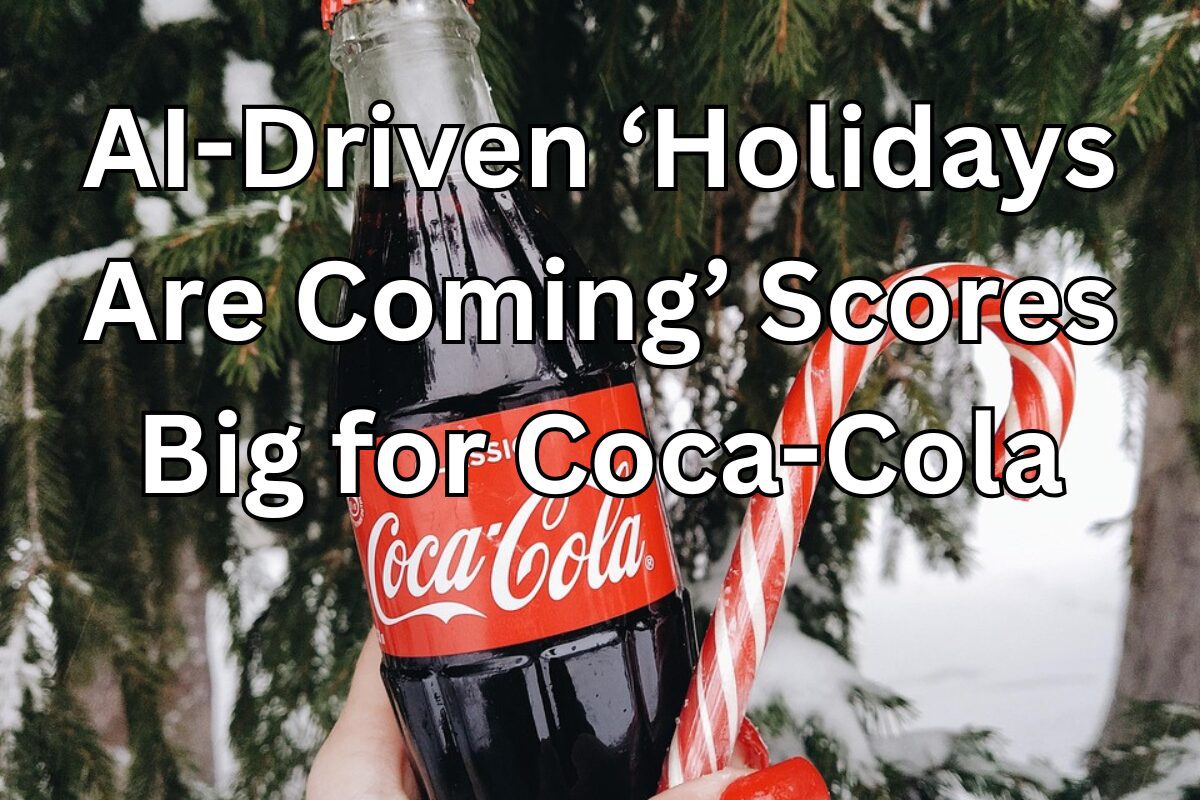
Coca-Cola is once again tinkering with one of the most recognisable Christmas ads in the world – and this time, it’s artificial intelligence that’s doing much of the heavy lifting.
For the second year running, the soft drink giant has leaned into generative AI to refresh its “Holidays Are Coming” campaign, even as a vocal minority criticises the approach.
Inside Coca-Cola, however, confidence is high. The new AI-generated holiday ad has “scored off the charts” with consumers, according to the company’s global vice president for creative strategy and content.
Updating a 1995 Classic With Cutting-Edge Tech
“Holidays Are Coming” is more than an ad – it’s a Christmas ritual. First launched in 1995, with its illuminated red trucks and jolly Santa, the spot has been repeatedly revived and reimagined over the decades.
Last year, Coca-Cola took its boldest step yet by using generative AI to remake the ad, seeking to preserve the emotional core while updating the visuals and storytelling for a new era.
This year’s version goes even further. Described internally as a “refreshed and optimised” iteration of last year’s AI-driven remake, the new ad harnesses advances in generative technology that simply did not exist twelve months ago, including tools like OpenAI’s GPT-5.
The goal is not just aesthetic polish, but a more precise alignment with the way audiences actually respond to the campaign.
Despite online backlash about the use of AI, ElDessouky is emphatic that the data tells a different story. They have said that this is one of their top-tested ads in history, period, noting that for most viewers, the technology behind the scenes is secondary to the emotional narrative on screen.
Backlash, Metrics and the ‘Silent Majority’
In the age of social media, any major brand move will attract commentary – and Coca-Cola’s AI experiments are no exception. Critics worry about over-reliance on algorithms, the displacement of human creatives and the perceived “artificial” feel of machine-generated imagery.
ElDessouky, however, draws a sharp line between online noise and real-world performance. They acknowledge that there is noise and there are people who talk and criticise, but argue that the broader audience is responding to what truly matters: the story.
They also added that consumers do not necessarily look behind the technology, instead they just look at the story that they’re receiving, and then they respond to it.
The response so far has been unequivocally positive in the metrics that matter most to Coke. Internal testing shows the AI-generated ad driving strong scores on association with the brand and on conversion to transaction.
In other words, it feels like Coca-Cola and it moves product – the holy grail of any seasonal campaign.
Balancing Timeless Values With Experimental Creativity
For Coca-Cola, AI is not a gimmick but a strategic tool. The company sees generative technology as a way to reuse and reframe a “timeless and timely framework” that keeps long-standing brand values front and centre while still pushing creative boundaries.
ElDessouky says advances in generative AI have actively encouraged the team to take more risks and they are going to keep going at it, to be honest, because it’s giving them the measurements, the metrics and the business results, and, at the same time, they are learning how to do things differently.
The philosophy is clear: if Coca-Cola does not stretch its comfort zones, audiences will simply move on without it. The ambition is not just to keep up with culture, but to invite consumers to move with them, discovering new ways to connect with a brand that has been part of the festive landscape for nearly a century.
‘A Holiday Memory’: Tradition, Product and Emotional Heroes
AI may be the headline-grabber, but Coca-Cola’s holiday marketing still has room for more traditional storytelling.
Alongside the AI-led “Holidays Are Coming” spot, the company is rolling out “A Holiday Memory,” a 30-second TV ad that was developed using more conventional production methods.
This film is designed to balance three key imperatives: centring the product, celebrating the heroes of the holidays and linking back to previous festive campaigns.
The narrative follows a mother decorating her home for the season. As she prepares her surroundings for the celebrations ahead, she recalls past holidays – the small gestures, the shared moments – and then pauses to reward herself with a classic Coke.
A snow globe features prominently, serving as a visual callback to last year’s digital experience in which fans could turn an AI-assisted conversation with Santa into a personalised snow globe for social media.
For Coca-Cola, details like this reinforce the idea that the brand lives in every holiday season and that ideas are rarely discarded. Instead, they are added to what the company calls its big bank of assets – a growing archive of characters, symbols and stories that can be recombined in new ways.
“A Holiday Memory” will run across North America, Latin America and Asia South-Pacific, reflecting the increasingly global nature of the brand’s holiday storytelling, even as it continues to tailor its executions for local audiences.
Personalisation at Scale: Listening to Different Christmas Cohorts
Behind the festive sparkle is a serious data and insight operation. Coca-Cola’s “Refresh Your Holidays” campaign is designed to be both global and deeply local, requiring close collaboration across human insights, connection and media teams.
Research revealed that while many different groups strongly associate Coca-Cola with Christmas, they do so for different reasons and bring different expectations to the brand.
Some might be drawn to nostalgia and family rituals, others to modern celebrations, social occasions or emerging cultural trends. The creative challenge, therefore, is to weave all these needs into a coherent set of executions that still feel unmistakably “Coke.”
To manage this, the company validates its creative work before launch, stress-testing the ads against multiple cohorts and markets, then tracks sentiment once they are live. The aim is to refine and adjust in real time, ensuring that the overall campaign remains resonant, relevant and respectful of regional nuances.
The ‘Three Cs’: Culture, Community and Commerce
“Refresh Your Holidays” is more than just a TV flight. Developed by WPP Open X and led by VML, with support from EssenceMedia.com, Ogilvy and Burson, the campaign spans online video, digital, out-of-home, social media, in-store activations and even on-pack executions.
Coca-Cola organises this sprawling effort around what it calls the “three Cs”: culture, community and commerce.
Culture encompasses the flagship spots and out-of-home creative that reach mass audiences and define the look and feel of the season. Commerce is how those ideas are brought to life in retail – from shelf visibility to point-of-sale experiences and promotional mechanics.
Community is the engagement layer: CRM programmes, collaborations with creators and experiential moments that invite people to participate more actively. This year, that includes a tour of the brand’s iconic Christmas trucks across November and December, a physical activation that remains particularly important for reaching younger audiences who want experiences, not just impressions.
As one executive puts it, the Christmas truck is a uniquely powerful asset: a piece of brand iconography that almost no other company can match. Coca-Cola joked that if you do not capitalise on it… it’s a crime. If you have an asset, you need to push it.
Old Icons, New Tools – and the Search for the Next Big Asset
From the red trucks to Santa Claus and the polar bears, Coca-Cola’s holiday assets are among the most recognisable in marketing history.
In the age of generative AI, the company does not see these elements as relics, but as foundations. The technology is there to uncover new insights and create new avenues of engagement built on top of what already works.
Looking ahead, ElDessouky hints that the company’s experiments may yet yield another cultural phenomenon – a new character or motif that joins Santa and the truck in the brand’s permanent gallery.
Maybe they will land on something that people love so much, that it becomes their own Labubu, they expressed, referring to the wildly popular collectible character that has captured the imagination of younger audiences in Asia and beyond.
The logic is simple: without trying, testing and occasionally provoking debate, Coca-Cola will never add to its arsenal of beloved holiday icons. With AI now integrated into its creative toolkit, the brand is betting that the next big festive asset could emerge from exactly this interplay between tradition and technology.
Conclusion: Christmas Past Meets Christmas Future
Coca-Cola’s 2025 holiday strategy is a study in contrasts: nostalgic yet experimental, data-led yet deeply emotional, global in scale yet tailored to local realities.
The refreshed AI-generated “Holidays Are Coming” spot sits alongside a more traditional TV narrative in “A Holiday Memory,” both of them supported by a far-reaching “Refresh Your Holidays” ecosystem that stretches from digital channels to in-store displays and the ever-popular truck tour.
There may be noise around the role of AI in creativity, but the company is guided by a straightforward compass: audience response and business outcomes. For now, the numbers suggest that viewers are less concerned with how the magic is made than with how it makes them feel.
By blending its century-old Christmas heritage with cutting-edge generative tools, Coca-Cola is not just keeping its holiday crown – it’s actively auditioning the next generation of icons that could define Christmas for decades to come.